

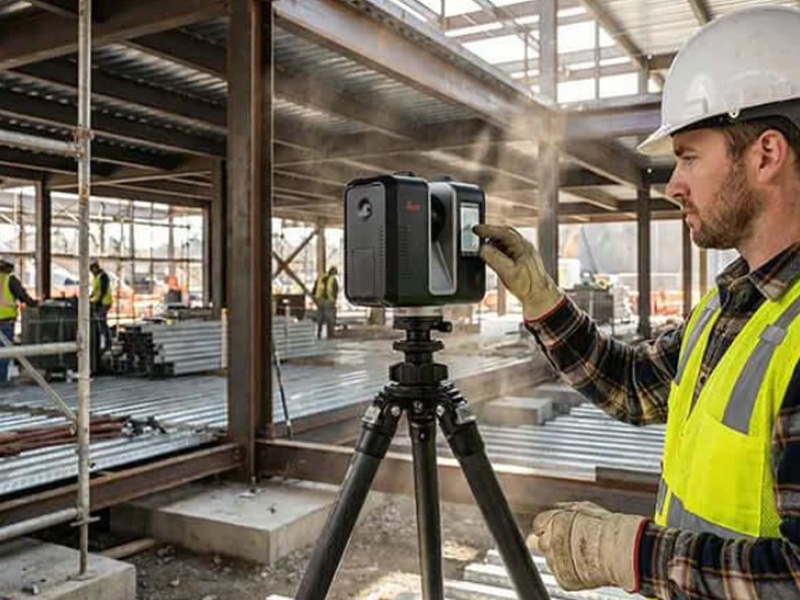
Yes, 3D laser scanning can help identify certain structural problems, particularly those that appear as measurable changes in the shape, position, alignment or geometry of a structure. However, it is not a standalone method for diagnosing every type of structural defect.
By providing highly detailed measurements of visible surfaces, 3D laser scanning can help identify changes such as deformation, displacement, settlement, misalignment and deflection. Comparing scans taken at different times can also help reveal measurable changes in a structure that may require further investigation.
However, problems occurring inside structural materials or those requiring material testing cannot generally be confirmed through laser scanning alone.
Table of Contents
ToggleWhat Structural Problems Can 3D Laser Scanning Identify?
3D laser scanning is particularly useful when a potential structural issue involves a change in geometry or position.Deformation
A scan can capture the existing shape of structural elements such as walls, columns, beams and floors. The resulting measurements can be compared with design information, reference geometry or previous survey data to identify deviations.Settlement
Repeated surveys can help identify changes in the elevation or position of structural elements. Where measurable movement occurs over time, scan comparisons can provide useful data for further engineering assessment.Displacement
If a structural element has moved from its previous position, comparison of different survey datasets can help quantify the change. This can be useful when investigating:- Horizontal movement
- Vertical movement
- Structural shifts
- Changes in position over time
Misalignment
Laser scanning can help identify geometric deviations such as:- Leaning walls
- Misaligned columns
- Structural frame deviations
- Irregular floor levels
- Changes from expected alignment
Deflection
Where suitable reference data and scan coverage are available, scanning can help measure changes in the shape or position of structural elements that may indicate deflection.The measured information can then be reviewed by an appropriately qualified professional to determine whether further investigation is necessary.
Can 3D Laser Scanning Detect Structural Cracks?
It can help document some visible surface irregularities, but it should not be treated as a complete crack-detection method. Large or clearly visible surface cracks may be represented in high-resolution scan data depending on their size, orientation, location and the quality of the scan.However, very narrow cracks or defects that are hidden, inaccessible or below the surface may not be reliably identified. If the purpose of the investigation is specifically to determine the presence, depth, cause or severity of cracking, additional inspection or testing may be required.
Can 3D Laser Scanning Detect Hidden Structural Damage?
This is one of the main limitations to understand. 3D laser scanning measures accessible surfaces. It does not see through concrete, walls or other structural materials.Therefore, a laser scan alone cannot reliably confirm conditions such as:
- Internal concrete deterioration
- Hidden reinforcement corrosion
- Internal voids
- Subsurface cracking
- Reinforcement damage
- Material strength problems
- Defects beneath surface finishes
How Can Scan Comparison Help Identify Structural Changes?
One of the most useful approaches is to compare multiple surveys of the same structure over time. A baseline scan can record the geometry of a structure at a particular point in time. A later scan can then be compared with the baseline to identify measurable changes.The comparison may reveal changes in:
- Elevation
- Position
- Alignment
- Surface geometry
- Structural shape
This type of comparison can be useful for monitoring structural changes, but identifying a change does not automatically establish its cause or whether it represents a safety concern.
What Can 3D Laser Scanning Not Confirm?
While laser scanning can provide detailed geometric information, there are several questions it cannot answer on its own.A scan cannot independently determine:
- Why a crack has developed
- Whether a structure is structurally safe
- The strength of concrete
- The condition of hidden reinforcement
- The cause of settlement
- The internal condition of a structural member
- Whether a measured deformation requires structural repair
Does 3D Laser Scanning Replace a Structural Inspection?
No. 3D laser scanning and structural inspection serve different purposes. A laser scan primarily provides accurate spatial and geometric information, while a structural inspection evaluates the condition and performance of the structure.For example, scanning may show that a wall has deviated from its expected alignment. The findings may then need to be reviewed by a structural engineer to establish:
- What caused the deviation
- Whether the movement is ongoing
- Whether it affects structural performance
- Whether additional testing is required
- What corrective action may be appropriate
When Is 3D Laser Scanning Useful for Structural Investigation?
3D laser scanning can be considered when a project requires accurate measurement of existing structural geometry or changes over time. Typical situations include:- Suspected structural deformation
- Monitoring of structural movement
- Settlement investigation
- Structural alignment checks
- Before-and-after condition comparison
- Measurement of existing structural geometry
- Documentation of changes between inspection periods
What Happens After a Structural Issue Is Identified?
Finding a geometric irregularity is generally the beginning of an investigation, not the final diagnosis. For example: Laser scan → Identify measurable deviation → Compare with reference data → Assess the change → Further engineering investigation if requiredDepending on the issue, additional methods may include visual inspection, structural monitoring, material testing or specialist investigation of reinforcement and concrete. The appropriate approach depends on the suspected problem and the requirements of the project.
Can 3D Laser Scanning Help Monitor Structural Movement?
Yes. Repeated scanning can provide datasets that can be compared to identify measurable changes in structural geometry. This can be useful where project teams need to monitor whether a structure or specific elements are changing position or shape over time.However, the survey frequency, reference system, measurement requirements and acceptable tolerances should be established according to the specific monitoring objective.
3D Laser Scanning: Detection vs. Diagnosis
It is useful to distinguish between detecting a change and diagnosing a structural problem| 3D Laser Scanning Can Help With | Further Structural Assessment May Be Needed For |
|---|---|
| Measuring deformation | Determining the cause of deformation |
| Measuring displacement | Assessing structural safety |
| Identifying misalignment | Determining the cause of misalignment |
| Comparing structural geometry | Assessing material condition |
| Monitoring changes over time | Diagnosing internal damage |
| Documenting visible conditions | Determining appropriate repairs |
Final Thoughts
3D laser scanning can play an important role in identifying measurable changes in a structure, including deformation, settlement, displacement and misalignment. Its detailed spatial data can help highlight areas that may need closer examination, particularly when scans are compared over time.However, it is not a replacement for a professional structural inspection. Hidden defects, material deterioration and the underlying causes of structural changes may require additional testing and engineering evaluation.
Used alongside appropriate inspection methods, 3D laser scanning can provide reliable geometric information to support better-informed structural assessments. Contact Accurate Survey Engineering to discuss your 3D laser scanning requirements in the UAE.