

What is 3D Laser Scanning?
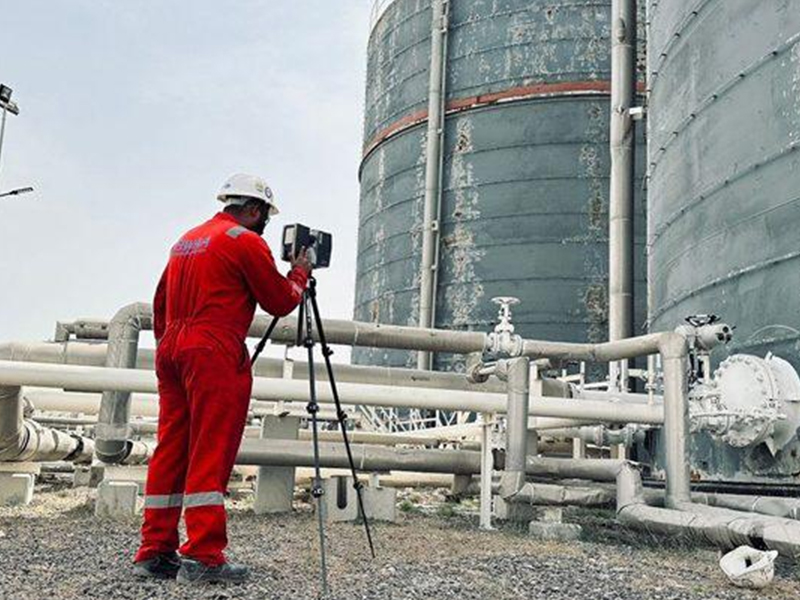
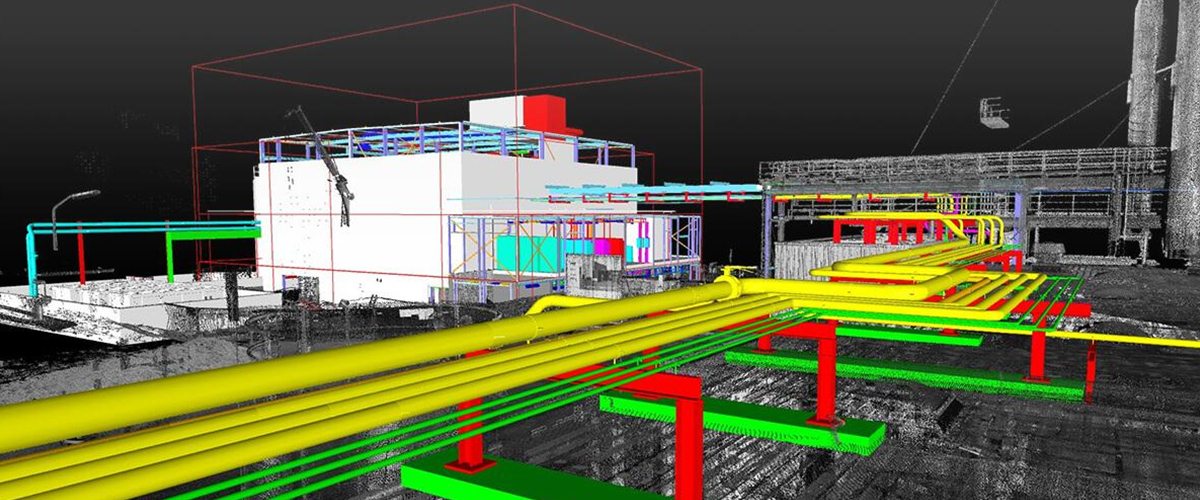
3D laser scanning is an advanced, non-contact measurement technology used to capture the exact shape and dimensions of physical environments. It works by emitting laser beams that bounce off surfaces and return precise data points. These points are collected in large volumes to create what is known as a point cloud.
This point cloud can then be converted into:
- Accurate 3D models
- As-built drawings
- BIM (Building Information Modeling) models
- Digital twins of industrial facilities
The result is a highly detailed and measurable digital representation of real-world structures, making it an essential tool for modern industrial projects.
Why Are Industrial Sectors Adopting 3D Laser Scanning?
Industries are rapidly adopting 3D laser scanning because it offers a powerful combination of speed, accuracy, and safety three critical factors that traditional surveying methods struggle to achieve together.
High-Speed Data Capture
3D laser scanners can collect millions of data points in minutes, significantly reducing the time required for site measurements. Projects that once took months can now be completed in days or weeks.
Exceptional Accuracy
With millimeter-level precision, laser scanning ensures reliable data for complex industrial environments. This level of accuracy is essential for tasks such as equipment installation, retrofitting, and structural analysis.
Improved Safety
Data can be captured from a distance, minimizing the need for personnel to enter hazardous areas such as confined spaces, elevated structures, or zones with active machinery and chemicals.
Better Decision-Making
Accurate digital models allow engineers and project managers to plan, design, and execute projects with confidence, reducing errors and costly rework.
The Shift Beyond Petrochemicals: Who Is Using 3D Laser Scanning Today?
The petrochemical industry was the early adopter, and for good reason. Refineries and chemical processing plants have enormous inventories of equipment that are frequently modified, and the cost of even a single measurement error can run into millions of dollars in downtime and rework. But the technology has since expanded well beyond hydrocarbons.
Oil & Gas and Petrochemical Plants
This remains the most mature application. 3D laser scanning supports everything from pipeline as-built documentation and piping isometric generation to turnaround planning and API 653 tank inspections. In the UAE, where national energy infrastructure is critical, major oil and gas operators use laser scanning to maintain accurate as-built records of facilities that have evolved over decades of modifications, often without consistent documentation updates.
One of the most valuable use cases is plant shutdown and turnaround planning. During a planned shutdown, every hour of extended downtime can represent hundreds of thousands of dollars in lost production. By using pre-shutdown laser scans to create an accurate digital model of the plant, engineering teams can design new components, plan modifications, and verify fabrication dimensions all before anyone sets foot on site during the shutdown window. This drastically reduces the field adjustments and unexpected clashes that traditionally cause costly overruns.
Power Generation Plants
Thermal, gas, and combined-cycle power plants are asset-intensive environments where maintenance precision is non-negotiable. 3D laser scanning enables detailed documentation of turbines, boilers, cooling towers, and associated infrastructure. When a plant requires modification, adding new capacity, replacing aging equipment, or integrating renewable energy systems, laser scanning provides the accurate geometric baseline that engineering teams need to design with confidence rather than guesswork.
Manufacturing and Heavy Industry
Manufacturing plants face a unique challenge; they evolve constantly. New production lines are added, equipment is repositioned, and layouts change to accommodate new products. Yet the official floor plans rarely keep pace. This gap between what’s documented and what’s actually on the floor is one of the most common sources of project delays and cost overruns when facilities are expanded or modified.
3D laser scanning closes that gap. It delivers an accurate, up-to-date digital record of the facility that engineers can use for layout planning, equipment installation verification, and clash detection before construction begins.
Pharmaceutical Manufacturing
Few industries face documentation requirements as strict as pharmaceuticals. Regulatory bodies require that any modification to a manufacturing environment be thoroughly documented, validated, and traceable. 3D laser scanning provides exactly the kind of accurate, auditable as-built record that regulatory compliance demands – and it does so far faster than traditional measurement methods. Any facility change, from HVAC modifications to cleanroom reconfigurations, can be documented with spatial precision and incorporated into compliance records.
Food & Beverage Processing
Hygiene and operational continuity are the twin pressures in food and beverage manufacturing. These facilities typically operate with very tight production windows, leaving little time for surveys that would require halting production lines. The non-intrusive nature of laser scanning means data can often be captured during brief maintenance windows or at shift changes, minimizing disruption while still delivering complete facility documentation.
Five Ways 3D Laser Scanning Transforms Plant Management
1. Accurate As-Built Documentation
One of the most persistent problems in industrial facility management is the gap between design drawings and reality. Original engineering drawings reflect what was planned, not what was actually built, and certainly not the decades of modifications that followed. This absence of accurate as-built documentation creates serious problems when facilities need to be modified, maintained, or expanded.
3D laser scanning solves this by capturing the exact current state of the facility with millimeter-level detail. The resulting point cloud and 3D model become the authoritative record of what exists, not what was designed to exist. This is particularly valuable in the UAE’s industrial sector, where many facilities are entering their second or third decade of operation, and original drawings are either outdated, incomplete, or unavailable.
2. Digital Twin Creation for Smarter Plant Management
A digital twin is a dynamic, data-rich virtual replica of a physical asset or facility. When a 3D laser scan is used as the geometric foundation of a digital twin, plant managers gain the ability to plan modifications, simulate operational scenarios, and coordinate maintenance activities in the virtual environment before any physical work begins.
The implications are significant. Engineers can design new tie-ins for additional process equipment, verify clearances for new pipelines, simulate equipment removal paths during maintenance, and identify spatial conflicts, all without physical access to the live plant. This reduces planned shutdown durations, cuts engineering costs, and dramatically lowers the risk of expensive field rework.
3. Clash Detection Before Construction
One of the costliest problems in industrial construction and modification projects is discovering clashes, unexpected conflicts between new and existing structures after fabrication has already begun or, worse, during installation. A single clash that forces a field modification can cost far more than an entire scanning and modeling project.
3D laser scanning eliminates this risk by capturing the as-built geometry of the existing plant with enough precision that engineers can overlay new design models and detect every potential clash before a single piece of steel is ordered. In complex brownfield environments, this capability alone typically pays for the scanning investment many times over.
4. Enhanced Maintenance and Inspection Programs
Maintaining the structural and operational integrity of industrial plant equipment, pressure vessels, storage tanks, structural steelwork, and rotating machinery requires regular inspection and accurate dimensional records. 3D laser scanning provides a baseline measurement dataset that can be compared against future scans to identify deformation, settlement, corrosion-related dimensional changes, or structural movement over time.
For storage tanks specifically, laser scanning enables precise dimensional surveys, measuring verticality, roundness, ovality, peaking, and banding, all critical parameters for tanks operating under API 653 or equivalent integrity standards. This replaces time-consuming manual measurement with a comprehensive scan that covers the entire tank geometry in a single operation.
5. Reverse Engineering of Critical Components
Industrial plants often contain equipment that has been in service for decades, with original manufacturer drawings long since lost or unavailable. When critical components fail and need replacement, the inability to source accurate dimensional data for custom-fabricated parts can cause extended downtime.
3D laser scanning enables reverse engineering of existing components with the geometric fidelity required to produce replacement parts or design compatible modifications. This is particularly valuable for older refineries, power plants, and chemical facilities in the UAE where legacy infrastructure is common.
Benefits of 3D Laser Scanning for Industrial Applications
- High Accuracy: Captures millions of data points with millimeter-level precision
- Time Efficiency: Faster than traditional surveying methods
- Cost Savings: Reduces rework, errors, and project delays
- Digital Integration: Supports BIM, CAD, and digital twin technologies
- Non-Disruptive Process: Data collection without interrupting operations
Safety: The Most Compelling Industrial Argument for 3D Laser Scanning
In any industrial environment, worker safety is the highest priority. Traditional manual surveying requires personnel to physically access every part of a facility that needs to be measured, including elevated pipe racks, confined spaces, hot environments near furnaces and reactors, and areas with potential chemical exposure. Each of these access requirements introduces a safety risk.
3D laser scanning fundamentally changes this equation. Because the technology is non-contact and operates from a distance, many measurements that previously required workers to climb scaffolding, enter confined spaces, or work near hazardous materials can now be captured from a safe, remote position. If the scanner can see the target, it can measure it without putting anyone at risk.
This capability is especially relevant during turnaround and maintenance activities, when plants are in their most hazardous state, and the pressure to complete work quickly is at its highest. Reducing personnel exposure in high-risk zones is not just a safety benefit, but it directly supports the goal of zero incidents that every responsible industrial operator shares.
Why UAE Industrial Facilities Are Accelerating Adoption
The UAE’s industrial infrastructure sits at an important inflection point. National initiatives around economic diversification, digital transformation, and smart industry are pushing organizations to modernize their operational approaches. At the same time, the region’s established oil and gas infrastructure is aging, with many facilities now requiring the kind of rigorous asset integrity management and brownfield expansion planning that 3D laser scanning enables.
Regulatory and audit frameworks are also becoming more demanding. Accurate, traceable as-built records are increasingly required for compliance with asset integrity standards, insurance requirements, and safety management systems. Laser scanning delivers the documented accuracy these frameworks demand, while generating data that remains valuable across the entire lifecycle of the facility.
There is also the practical reality that the UAE’s industrial sector, from ADNOC’s downstream operations to the Khalifa Industrial Zone’s manufacturing cluster, operates in an environment where project budgets are scrutinized and downtime is expensive. The business case for 3D laser scanning is straightforward: faster surveys, fewer errors, lower rework costs, and safer working conditions.
Future of 3D Laser Scanning in Industrial Sectors
As industries move toward smart factories and digital transformation, 3D laser scanning will play a key role in:
- Digital twin creation
- AI-driven maintenance
- Smart asset management
- Predictive analytics
What to Look for in a 3D Laser Scanning Company?
Not all 3D laser scanning services deliver the same value. When selecting a partner for industrial plant scanning in the UAE, the key considerations go beyond equipment specifications.
- Engineering-grade output: Raw point clouds are a starting point, not a deliverable. The value comes from accurate 3D models, as-built drawings, BIM models, and clash detection analyses derived from the scan data. A capable partner delivers engineering-ready outputs that your team can put to work immediately.
- Industry experience: Industrial environments have specific requirements around operational protocols, safety standards, and technical deliverables. Experience working in live petrochemical plants, power stations, or manufacturing facilities is essential.
- Data management capability: Large-scale industrial scans generate massive datasets. The ability to manage, process, and deliver that data efficiently and in the formats your engineering software requires is a practical differentiator.
- Proven accuracy: Millimeter-level precision is only valuable if it can be verified. A trustworthy scanning partner demonstrates accuracy through traceable survey control networks and validation processes.
Why Choose Accurate Survey for 3D Laser Scanning in UAE?
For reliable and precise 3D laser scanning services in the UAE, Accurate Survey Engineering offers industry-leading expertise and technology.
- Advanced Scanning Technology: High-resolution laser scanners for maximum accuracy
- Experienced Team: Skilled professionals with industrial project experience
- Fast Turnaround: Efficient data capture and delivery
- Industry-Specific Solutions: Customized services for petrochemical, manufacturing, and infrastructure sectors
Conclusion: The Digital Future of Industrial Plant Management
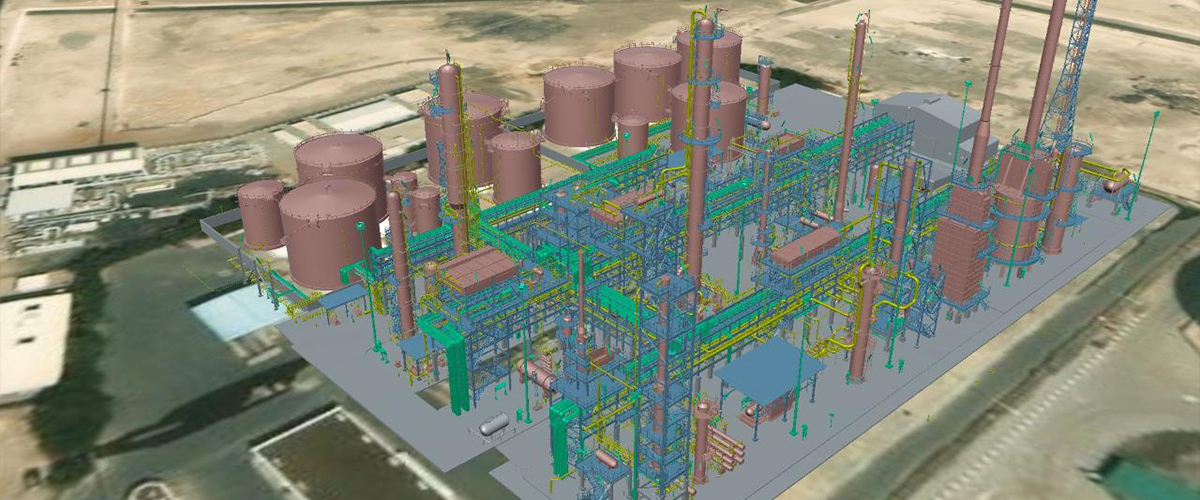
3D laser scanning is no longer an emerging technology; it is a proven, mature solution that is fundamentally changing how industrial plants are documented, managed, maintained, and modified. Whether the goal is accurate as-built documentation, digital twin creation, shutdown planning, safety improvement, or regulatory compliance, laser scanning delivers results that traditional surveying simply cannot match.
For industrial operators in the UAE and across the GCC, the question is not whether to adopt 3D laser scanning, but how to deploy it most effectively across their facility portfolios. The organizations that move fastest will carry a genuine operational advantage in cost control, project delivery, safety performance, and asset integrity.
Accurate Survey brings deep expertise in 3D laser scanning for industrial applications across the UAE. Our team delivers precise, engineering-ready scan data and 3D models that empower plant engineers, project managers, and maintenance teams to make better decisions, faster and with greater confidence.