

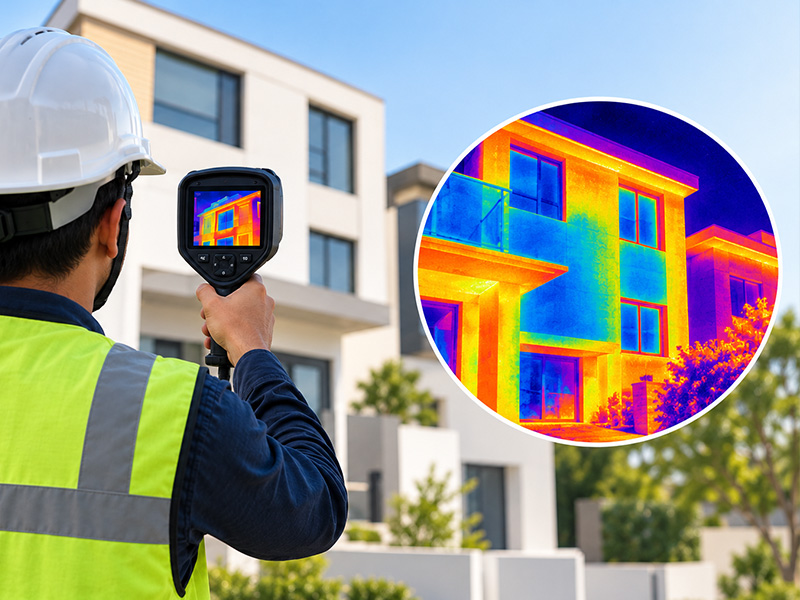
A building can appear perfectly normal while problems develop behind walls, ceilings, floors, or within building systems. Some issues do not leave obvious visual signs until the damage has progressed significantly. This is where thermal imaging can provide valuable insight.
Thermal imaging uses an infrared camera to record temperature differences across surfaces. Instead of relying solely on what is visible during a conventional inspection, a thermal survey can highlight unusual temperature patterns that may indicate moisture, insulation deficiencies, air leakage, or problems with electrical and mechanical systems.
Because the inspection is non-invasive, large areas can be assessed without opening walls or removing finishes. This makes thermal imaging useful for building inspections, maintenance planning, troubleshooting, and identifying potential problems at an early stage.
Here are seven common building problems that thermal imaging can help identify.
Table of Contents
Toggle1. Moisture Intrusion and Damp Areas
Water-related problems are among the issues that can remain hidden for a considerable period. A small leak behind a wall, ceiling, or finished surface may not immediately produce visible staining.
Thermal imaging can help locate areas with unusual temperature patterns associated with moisture. When environmental and surface conditions create sufficient thermal contrast, damp sections may appear differently from surrounding dry areas on an infrared image.
This can help inspection teams narrow down areas that require further investigation.
Common sources of moisture-related problems include:
- Roof and waterproofing failures
- Plumbing leaks
- Water entering through external walls
- Air-conditioning condensate problems
- Moisture around windows and openings
- Dampness beneath finished surfaces
Thermal imaging does not replace moisture meters or other diagnostic methods, but it can help identify suspicious areas efficiently before more detailed testing is carried out.
2. Missing or Damaged Thermal Insulation
Insulation plays an important role in controlling heat transfer through a building envelope. When insulation is missing, poorly installed, damaged, or unevenly distributed, sections of a wall, ceiling, or roof can behave differently from the surrounding area.
An infrared camera can reveal these temperature variations when appropriate conditions are present.
For example, an area with insufficient insulation may appear noticeably different from adjacent sections of the same surface. This can help identify potential insulation deficiencies without removing wall or ceiling finishes.
Thermal imaging can therefore be useful when assessing:
- Roof insulation
- External walls
- Ceiling systems
- Insulated pipework
- Areas around building openings
- Recently completed insulation work
Identifying insulation problems early can support maintenance decisions and help reduce unnecessary energy losses.
3. Air Infiltration and Unwanted Heat Transfer
Gaps around doors, windows, service penetrations, and other building openings can allow unwanted air movement. These areas may contribute to uncomfortable indoor conditions and increased heating or cooling demand.
Under suitable temperature and pressure conditions, thermal imaging can make these patterns easier to identify.
An infrared survey can highlight temperature differences around:
- Window frames
- Door frames
- External wall junctions
- Roof interfaces
- Service penetrations
- Other potential air leakage points
Once an unusual thermal pattern has been identified, additional testing can be used to determine whether air movement is actually responsible.
This makes thermal imaging particularly useful as an investigative tool rather than relying solely on visual inspection.
4. Cold Bridging Around Building Components
A thermal bridge is an area where heat moves through a building element more readily than through the surrounding construction. These areas can occur around structural elements, junctions, openings, balconies, or locations where insulation has been interrupted.
Cold bridging can affect thermal performance and may also contribute to condensation under suitable conditions.
Thermal imaging can make these temperature differences visible across a building surface. This allows inspection teams to identify areas that may require closer assessment.
Typical locations include:
- Wall-to-floor junctions
- Wall-to-ceiling connections
- Window and door openings
- Structural interfaces
- Balcony connections
- Changes in construction materials
Detecting these patterns can help building owners and engineers investigate potential weaknesses in the building envelope.
5. Electrical Overheating
Electrical systems can generate heat when current passes through components. An abnormal temperature increase may occur when there is a loose connection, excessive electrical load, deteriorated component, or another fault condition.
Thermal imaging allows electrical components to be inspected without physically touching them during operation, subject to appropriate safety procedures.
An infrared survey may help identify unusual heat patterns around:
- Electrical panels
- Switchgear
- Circuit breakers
- Cable connections
- Distribution boards
- Other accessible electrical components
An abnormal thermal pattern does not automatically confirm the cause of a fault. However, it can indicate an area that deserves further examination by a qualified electrical professional.
Early identification of overheating components can support preventive maintenance and help reduce the risk of equipment damage or unplanned downtime.
6. HVAC and Mechanical Equipment Problems
Heating, ventilation, and air-conditioning systems are essential to maintaining comfortable indoor environments, particularly in buildings operating under demanding climate conditions.
Thermal imaging can help assess temperature distribution across accessible mechanical equipment and components. Differences from expected thermal patterns may indicate areas that require further investigation.
Depending on the system and inspection conditions, thermal imaging can assist in examining:
- HVAC equipment
- Motors
- Pumps
- Mechanical connections
- Ductwork
- Piping systems
- Heat-producing components
For example, an unexpected temperature difference across a mechanical component may point to an issue with operation, heat transfer, insulation, or another condition.
When combined with equipment specifications and other inspection methods, thermal data can contribute to a more informed maintenance assessment.
7. Uneven Temperature Distribution in Building Systems
Not every thermal anomaly indicates damage. Sometimes the issue is simply that a building system is not performing uniformly.
Thermal imaging can help identify variations in temperature across walls, ceilings, floors, equipment, or other accessible surfaces. These patterns can provide useful information when investigating inconsistent heating or cooling performance.
For example, an inspection may reveal areas that are significantly warmer or cooler than adjacent sections. Further investigation can then determine whether the cause is related to insulation, air movement, HVAC performance, moisture, construction details, or another factor.
This makes thermal imaging valuable for troubleshooting situations where the source of a building performance problem is not immediately obvious.
Why Use Thermal Imaging for Building Inspections?
One of the main advantages of thermal imaging is that it provides information that may not be visible during a conventional visual inspection.
A thermal survey can:
- Cover large areas relatively quickly
- Identify temperature differences across surfaces
- Help locate areas requiring further investigation
- Reduce the need for unnecessary invasive inspection
- Support preventive maintenance
- Assist with troubleshooting building performance issues
- Provide visual thermal records for documentation
However, thermal imaging should be interpreted correctly. Environmental conditions, surface materials, reflected heat, weather, equipment operating conditions, and the temperature difference between an object and its surroundings can all affect the results.
For this reason, a thermal image should not be treated as proof of a defect by itself. The findings should be interpreted by experienced professionals and, where necessary, verified using appropriate inspection or measurement methods.
When Should a Building Have a Thermal Imaging Survey?
A thermal imaging survey can be considered in several situations, including:
- When unexplained dampness or water intrusion is suspected
- After insulation installation or building-envelope work
- When electrical equipment shows signs of abnormal operation
- When HVAC performance appears inconsistent
- During preventive building maintenance
- When occupants experience unexplained hot or cold areas
- Before planning more invasive investigations
- When a building owner wants to investigate potential energy or heat-loss issues
The appropriate inspection approach depends on the building, its systems, environmental conditions, and the specific problem being investigated.
How Thermal Imaging Supports Preventive Maintenance
Waiting until a building problem becomes visually obvious can result in more extensive repairs. Thermal imaging offers a way to identify unusual patterns that may warrant investigation before a problem develops further.
For facility managers, property owners, contractors, and engineers, this can support a more proactive approach to maintenance.
Instead of investigating an entire building blindly, thermal data can help narrow the focus to specific areas that show unusual temperature behaviour. Additional testing can then be targeted where it is most useful.
Accurate Survey Engineering for Thermal Imaging and Mapping
Accurate Survey Engineering provides professional thermal imaging and mapping services for identifying temperature variations and potential issues that may not be visible during a conventional inspection. Using infrared thermal imaging technology, the company provides detailed insights into building, electrical, mechanical, and environmental conditions.
The service can be used to investigate potential moisture intrusion, insulation deficiencies, air infiltration, cold bridging, electrical overheating, HVAC-related issues, and other abnormal thermal patterns. By identifying areas that require closer examination, thermal imaging can help engineers and property professionals carry out more targeted investigations.
Accurate Survey Engineering provides thermal imaging solutions for a range of inspection requirements, helping clients obtain useful thermal data for building assessment, troubleshooting, preventive maintenance, and condition evaluation.
For professional thermal imaging and mapping services, contact Accurate Survey Engineering to discuss your project requirements.